Mobile phone: 18815239758 (same as WeChat)
Phone: 0576-89881178
Phone: 0576-89825885


The main function of the computer safety valve calibration bench is to use high-pressure air as the medium to test the sealing performance, popping pressure, and reseating pressure of the safety valve.
Typical applications: Performance testing of spring-loaded safety valves, safety valves with power assisted functions, and safety valves with supplementary loads.
Technical parameters
Safety valve mounting socket (optional)
1. DN100 safety valve mounting socket
Safety valve opening: DN15 to DN100
Maximum tuning pressure: PN 32MPA
Maximum loading force: 50KN
Working medium: clean air, nitrogen
Working temperature: 0-50 ℃
Driving gas source: 0.3~0.8MPa
2. DN200 safety valve mounting socket
Safety valve opening: DN100 to DN200
Maximum tuning pressure: PN 16MPA
Maximum loading force: 100KN
Working medium: clean air, nitrogen
Working temperature: 0-50 ℃
Driving gas source: 0.3~0.8MPa
3. DN400 safety valve mounting socket
Safety valve opening: DN200 to DN400
Maximum tuning pressure: PN 8MPa
Maximum loading force: 300KN
Working medium: clean air, nitrogen
Working temperature: 0-50 ℃
Driving gas source: 0.3~0.8MPa
a) Pressure range: 0-32MPa, maximum output pressure 40MPa;
b) Test medium: air;
c) Test pressure output: 1 channel;
d) Test valve diameter: DN 15-400mm
e) Pressure control accuracy: ≤± 1% F.S;
f) Pressure measurement accuracy: 0.4 level pressure gauge (optional higher pressure level);
g) Pressure gauge measurement range: 0-2.5MPa, 0-10MPa, 0-25MPa, 0-40MPa, (can be selected according to requirements)
h) Clamping method: hydraulic cylinder clamping or pneumatic clamping;
i) Clamping force output range: 0-50 tons;
j) Sealing method: sealing ring sealing;
k) Drive gas source: ≤ 7 bar, maximum gas consumption: 0.8 standard cubic meters per minute;
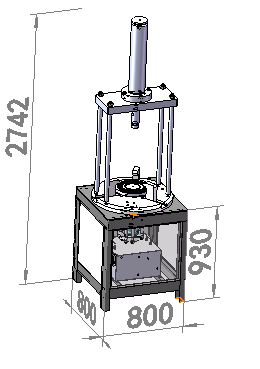
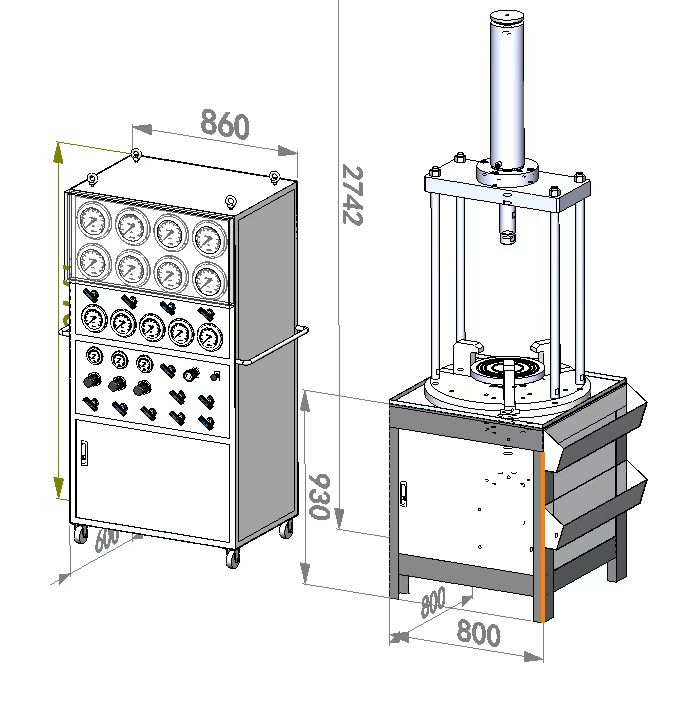
l) Dimensions: 1550 × 1120 × 1650 (host)+860 × 860 × 700 (fixture)+850 × 600 × 1000 (hydraulic station);
m) Compressed air quality requirements: filtration accuracy: 15 μ m; Atmospheric dew point: 3 ℃; Oil content (PPM): ≤ 5.0
System Features
a) The high-precision pressure regulating valve adjusts the output pressure and manually controls the testing process through the button switch on the control cabinet.
b) By utilizing pneumatic boosting technology, the pressure is stabilized and maintained smoothly without fluctuations, and the output pressure can be adjusted.
c) Automatic clamping system, convenient for quick installation and positioning of valves.
d) The clamping pressure source adopts a gas-liquid booster pump, which has high pressure and can automatically supplement pressure to ensure the stability of the system pressure during the pressure testing process and prevent the safety valve from loosening;
e) All high-pressure valves, fittings, and joints are made of 316 material, and the system adopts non welded connections and conical sealing, which is suitable for the sealing requirements of the vast majority of hydraulic systems;
f) Ensure voltage resistance level, safety and reliability, and suitable for most media;
g) The workbench adopts a three jaw form, with stable output force and uniform distribution;
h) Adopting a 0.4 level pressure gauge and providing different range pressure gauge distributions to improve detection accuracy;
i) We have jointly developed high-quality pneumatic liquid booster pumps and pneumatic gas booster pumps with Germany, as well as imported Parker and SMC high-quality pneumatic components, ultra-high pressure valves, fittings, and joint quality products.
j) The equipment can be equipped with pressure gauges according to customer needs and reserve an external interface to facilitate customers to replace the pressure gauge based on the actual detected pressure.
 Safety valve calibration bench