
Mobile phone: 18815239758 (same as WeChat)
Phone: 0576-89881178
Phone: 0576-89825885


How to achieve self cooling of the pneumatic gas booster pump itself?
As is well known, the emergence of gas booster pumps has brought great convenience to factory production and life. Gas booster pumps can be used for local gas boosting or secondary boosting of high-pressure gas. Therefore, we all understand that gas volume decreases and steadily rises after compression. The friction between the piston ring of the high-pressure chamber and the high-pressure cylinder body heats up, and the temperature rise due to gas compression causes the booster pump to stop working during use and wait for a period of time before continuing to use.
The Feentor high-pressure gas booster pump itself has a self cooling method, which allows the pneumatic gas booster pump to use the gas consumed by driving and its own airflow output structure to achieve cooling of the booster pump during operation.
We all know that when a gas booster pump works back and forth, it needs to be driven by gas to make the pump body move. The consumption of a gas booster pump is between 0.5m ³ and 1m ³ per minute. So the process of driving air to be discharged during the movement of the booster pump is a process where the driving air is instantly released at 6-8 bar and becomes 0 bar during the inflation process. The instantaneous discharge of the driving air causes a decrease in the surrounding temperature. So we can look at the following chart.
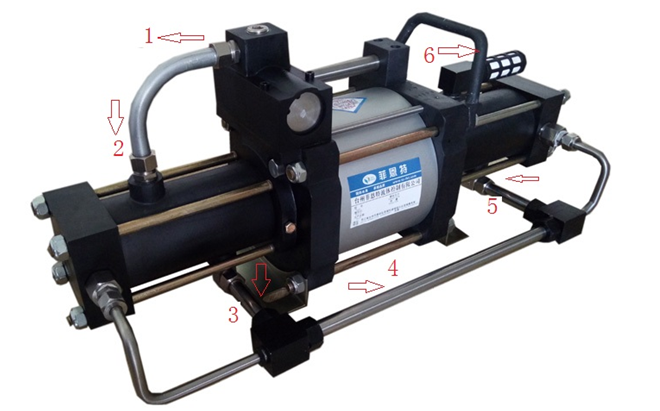
Position 1 is the air that drives the air to be consumed and discharged. It enters the outer shell of the high-pressure chamber of the booster pump at 2 points (note: there is a cooled shell outside the high-pressure cylinder body of the Feentor high-pressure pneumatic booster pump, which cools the internal high-pressure cylinder, and then passes through the high-pressure pipeline at 3 and 4 points. There is a cooling sleeve outside the high-pressure pipeline to supply cooling gas for transportation. Then it enters the high-pressure pump body at the other end at 5 points for cooling, and is discharged into the atmosphere through the muffler at 6 points).
The gas booster pump can fully utilize the consumption of driving air in such a cooling process to achieve cooling of the pump body, thereby increasing the lifespan of the pump.
 气体增压设备
