
Mobile phone: 18815239758 (same as WeChat)
Phone: 0576-89881178
Phone: 0576-89825885


Hydraulic testing equipment
1、 Application scope
The hydraulic testing equipment developed by Taizhou Feentor Fluid Control Co., Ltd. can be used for water pressure and oil pressure resistance testing of equipment such as pipes, valves, containers, gas cylinders, hoses, and rubber hoses. It can be operated in two modes: manual control and automatic control. Automatic operation can print reports, display pressure curves, and save Excel spreadsheet data.
2、 Characteristics of hydraulic testing equipment
1. It can achieve adjustable and controllable output pressure.
2. It can display pressure curves in real time, print reports, and save test data.
3. Computer controlled boost rate.
4. The pressure can be adjusted within a wide range. High control accuracy.
3、 Technical parameters of hydraulic testing equipment
1. Driving pressure range: 0.1-0.8 Mpa; And the output pressure is directly proportional to the driving air pressure.
2. Gas consumption: 1Nm3/min
3. Pressure testing range: 0-300Mpa.
4. Working medium: water, oil, emulsion.
5. Automatic test recording and output of test reports can be achieved through data collection software, and Excel test data can be saved.
6. Can be used for static pressure testing, strength testing, fatigue testing, destructive testing, etc. of equipment.
4、 Core components and accessories of hydraulic testing equipment
Core component: gas-liquid booster pump
A gas-liquid booster pump is a pump product powered by compressed air, based on the principle of area difference, which continuously outputs hydraulic oil at a fixed boosting ratio and is used to drive hydraulic actuators. The gas-liquid pump operates in automatic circulation. In the initial stage of compressed air connection, it acts as a regular liquid delivery pump, with fast circulation speed and high output liquid flow rate. As the output pressure gradually increases, the resistance borne by the piston also increases, and the circulation speed of the pump slows down.
When the reaction force of the output pressure reaches equilibrium with the pneumatic driving force, the pump will automatically stop. At this point, the pump is in a pressure holding state without consuming any energy, thus providing an economical power source.
When there is a decrease in output pressure due to leakage or other reasons, or when the provided gas source pressure increases, the pump will immediately start, thanks to its low friction resistance and ensuring the reliability of output pressure.
Advantage
1. Due to the ability to maintain pressure for a longer period of time without additional energy consumption, it saves energy.
2. There is no increase in oil temperature, so it is suitable for use in summer and hot and humid places without ventilation.
3. The gas-liquid booster pump does not require a power source, so it is suitable for situations without a power source.
4. Small in size and flexible in configuration, it can come with its own fuel tank or be installed on the machine tool, utilizing the space of the bed to save production area.
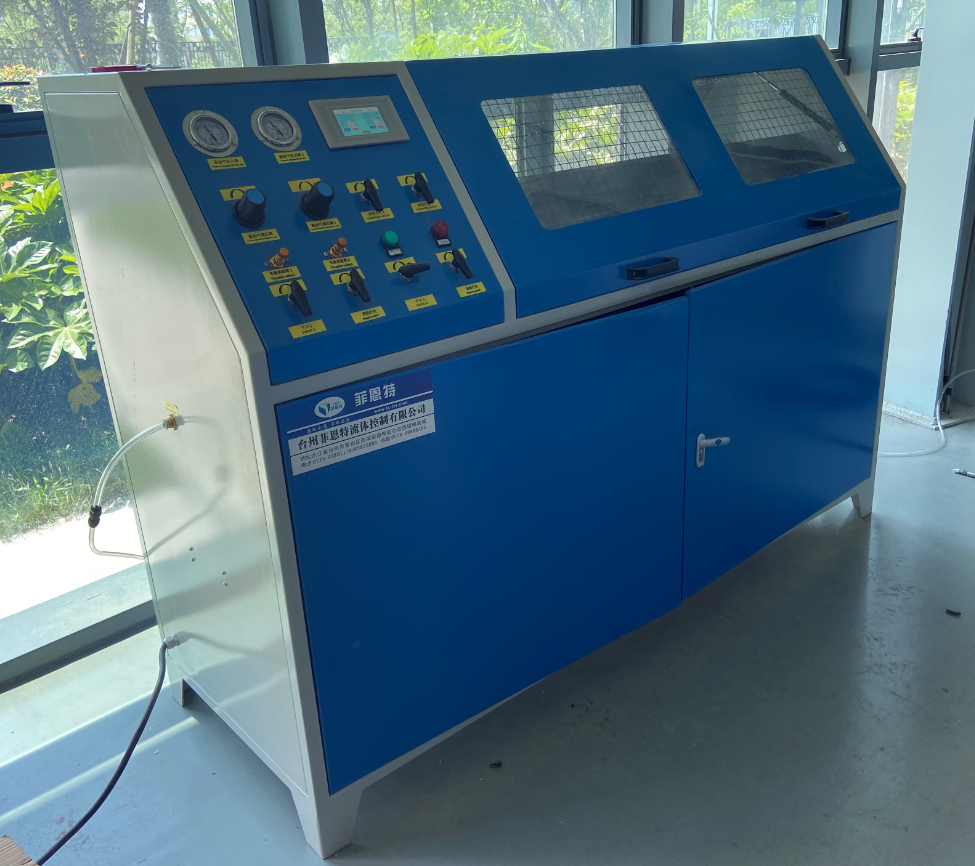
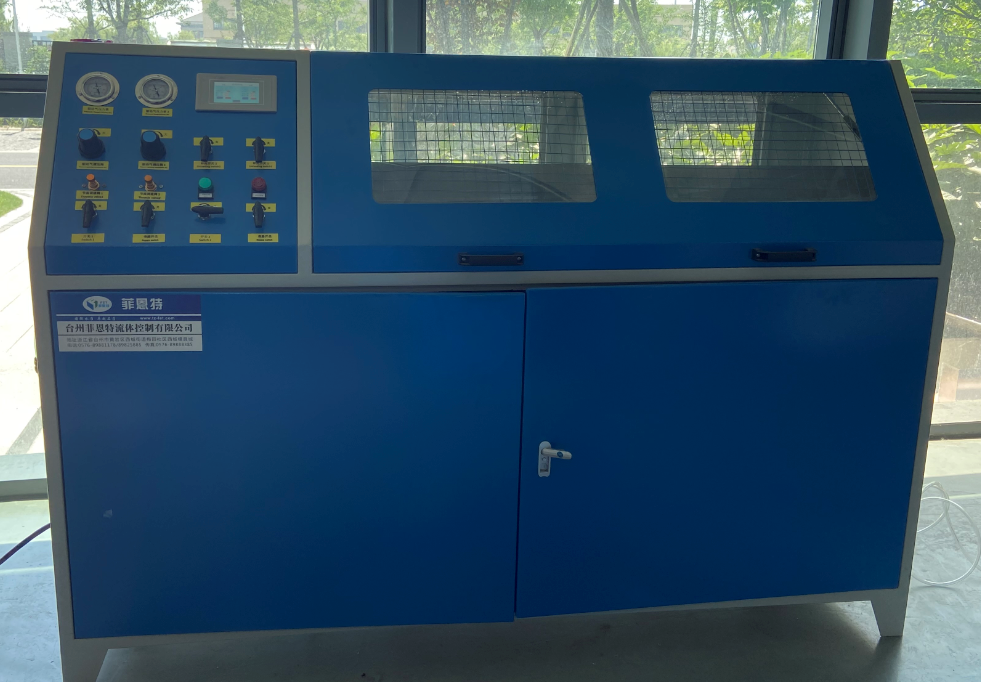 Hydraulic testing equipment
5. Do not cause pollution to the environment.
Manual control: Manual control involves adding a stainless steel casing to the gas-liquid booster pump, driving the pressure gauge, driving the pressure regulating valve, liquid high-pressure pressure gauge, driving switch, high-pressure switch, and unloading valve. The advantage lies in its high cost-effectiveness and simple operation.
Automatic control: It is based on manual control and adds computer control to achieve real-time display of test time, test pressure values, etc. It can perform data processing and analysis, and the experimental results can be automatically saved and printed out. Automatically save test results after power failure. It can achieve unmanned pressure testing on-site. The range of pressure alternation can be freely set, such as 0-30MPA or 10-45MPA. Equipped with leakage monitoring function in case of overvoltage, it can automatically alarm and shut down.
