
Mobile phone: 18815239758 (same as WeChat)
Phone: 0576-89881178
Phone: 0576-89825885


With the rapid development of today's society, the demand for gas sources in various industries and factories is becoming increasingly diversified, from a single gas source (air compressor gas and steam) to now diversified (oxygen, nitrogen, gaseous carbon dioxide, ammonia, argon, etc.), from a single pressure (3-8 bar) to multiple adjustable pressures (0-800 bar). Due to the different media and required pressures of various fluids, there are corresponding air pressurization systems and gas pressurization systems. Below, the editor will explain the differences and maintenance points between these two systems.
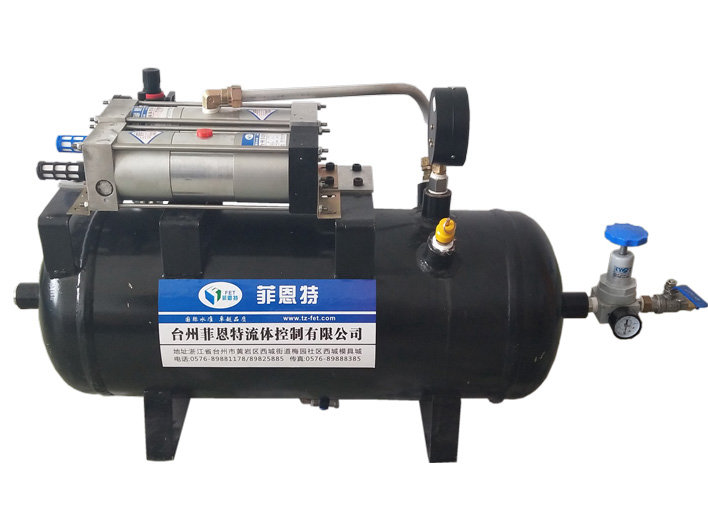
Firstly, let me explain the differences between air boosting systems and gas boosting systems. For example, the core component of the Feentor ZTS-ZTM02 air boosting system is the ZTM02 air boosting pump. This air boosting pump uses a combination of a boosting cylinder and a driving cylinder, which ensures that the volume of the air boosting pump is minimized and the flow rate is increased. However, the disadvantage is that a small amount of air outside the boosting air will enter the boosted gas with the operation of the boosting pump, resulting in a decrease in purity. For users who do not have strict purity requirements, this can be ignored. For gas boosting systems such as the Feentor ZTS-ZTA02 gas boosting system, the advantage is that the purity of the gas after boosting will not be affected in any way, because the boosting cylinder and the driving cylinder are separated and sealed, so there is no possibility of gas leakage. The disadvantage is that the separation of the booster cylinder and the drive cylinder results in a larger volume and correspondingly lower flow rate compared to an air booster pump with the same boost ratio. Summary: Gas boosting systems can be used for air boosting. Air boosting systems can be used for boosting gases with low purity requirements, but not for those with strict requirements.
Let me explain the key points of maintenance again: Poor maintenance can affect the service life of the air and gas boosting systems. After purchasing the boosting system, the first thing to pay attention to is whether there is too much dust in the on-site environment, and if necessary, install a dust cover. Is there any moisture in the on-site driving air source? If so, a dryer and filter should be added. After the preliminary work is ready, maintenance is left in the later stage. During maintenance, it is necessary to regularly add oil to the two couplings to ensure that there is always oil in the two couplings (check once a month), and regularly clean the dust on the booster pump (the booster pump has a self-priming function, and too much dust can easily suck into the interior, causing damage to the high-pressure seal and cylinder). Regularly open the drain valve under the gas storage tank to drain water (the gas will condense moisture when the airflow is too high) (the drainage time is determined according to the frequency of use). Regularly check whether the safety valve can be used normally and whether the high-pressure pipeline is aging (once a year). If possible, replace the sealing ring regularly (once every 2 years).
If you take good care of the air and gas boosting systems, you will find that they can be used for many more years than others.

Related Recommendations: Air Boosting Pump Video Gas Boosting Pump Video Air Boosting System Video Gas Boosting System Video
Legal statement: The above content belongs to the copyright of Taizhou Feentor - Plagiarism will be prosecuted
