
Mobile phone: 18815239758 (same as WeChat)
Phone: 0576-89881178
Phone: 0576-89825885


Three gas boosting schemes for laser cutting
Laser cutting machines require different auxiliary gases to cut different materials. The pressure and required flow rate of the auxiliary gas vary depending on the thickness of the cutting material.
The auxiliary gas of laser cutting machine is mainly used for:
1. Laser gas (gas used in the laser generator to generate laser)
2. Compressed air (usually used to protect the optical path, some manufacturers also use it as a protective gas)
3. Auxiliary gas (referring to the gas sprayed from the cutting nozzle of the cutting machine)
Oxygen is used for cutting carbon steel, and its purity requirement is generally 99.5% or higher. The main function is to assist combustion and blow off the melted material during cutting. The pressure and flow rate vary among laser cutting machine manufacturers, which is closely related to the size of the cutting nozzle and the thickness of the cutting material plate. The general requirement is a pressure of 0.3-0.8Mpa, and the cutting mouth is generally 0.02-0.05Mpa. The flow rate is hard to say, for example, when cutting 22mm carbon steel, some manufacturers require a flow rate of up to 10M3/h (including oxygen for the protection of double-layer cutting nozzles).
Cutting stainless steel requires the use of nitrogen gas, which is used to prevent oxidation reactions and blow away molten materials. There are high requirements for the purity of nitrogen gas (especially for stainless steel above 8mm, which generally requires a purity of 99.999%). The pressure requirement is relatively high, usually above 1Mpa. If you want to cut stainless steel above 12mm or thicker to 25mm, the pressure requirement is higher, above 2Mpa or higher. The flow rate varies depending on the type of cutting nozzle, but they are all large. For example, some manufacturers require 150m3/h for cutting 12mm stainless steel and below 50m3/h for cutting 3mm stainless steel.
In the process of laser cutting, the auxiliary gas must have sufficient pressure to thoroughly remove the waste generated during cutting. Generally, when cutting thicker workpieces, the air pressure should be reduced slightly, and the residue adhering to the workpiece will damage the cutting edge.
Increasing gas pressure can advance cutting speed, but once it reaches a high value, continuing to increase gas pressure can actually cause a decrease in cutting speed. The reason for the decrease in cutting speed under high auxiliary gas pressure can be attributed not only to the enhancement of the cooling effect of the hanging action zone by the high airflow velocity, but also to the interference of intermittent shock waves in the airflow on the cooling of the laser action zone. There are uneven pressures and temperatures in the airflow, which can cause changes in the density of the airflow field. This density gradient causes a change in the refractive index within the field, resulting in the focusing of the beam energy and causing refocusing or beam divergence. This interference can affect the melting efficiency and sometimes alter the mode structure, leading to a decrease in cutting quality if the beam diverges too much. Making the light spot too large can even result in serious consequences such as ineffective cutting.
Corresponding to three types of auxiliary gas pressurization, the following solutions can be developed based on the pressure level and different media.
1: Air boosting and stabilizing output, the flow rate of air used for laser cutting is basically not large, and the pressure is maintained at 0.6-1.5Mpa. In this case, the Feentor ZTS-ZTA02 air boosting system can be equipped. If the original air pressure is 0.8Mpa, the pressure after boosting can reach 2Mpa. Reduce the pressure to the desired level through a pressure reducing valve. If the cutting nozzle model is large and the flow rate cannot be reached, ZTS-ZTA02-F can be used (F represents multiple units in parallel until the flow rate can be met).
2: For oxygen and nitrogen, due to the requirement that gas purity cannot be reduced, the Feentor ZTS-ZTA05 gas boosting system can be used (this boosting system can increase the pressure of the pressurized medium to 4Mpa under a driving pressure of 0.8Mpa). The boosting cylinder operates independently during the boosting process without causing a decrease in purity or secondary pollution. Higher pressure can be addressed by contacting sales. The ZTS-ZTD10 system can increase the pressure to 8Mpa. If the traffic cannot be reached, multiple devices can be connected in parallel.
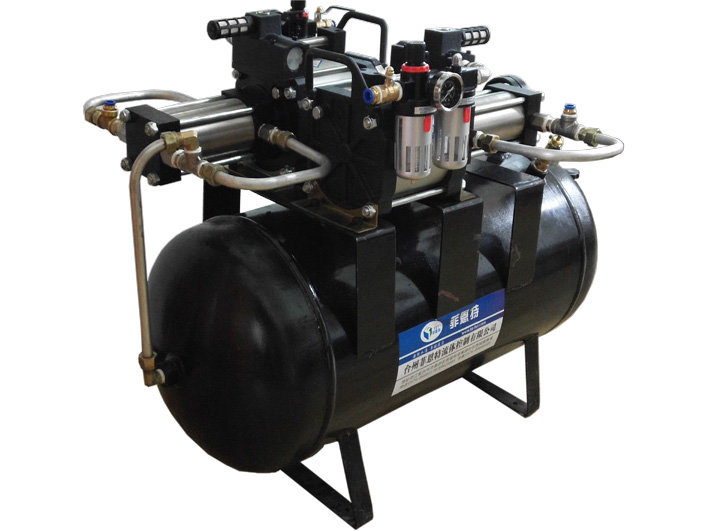 High pressure gas boosting system
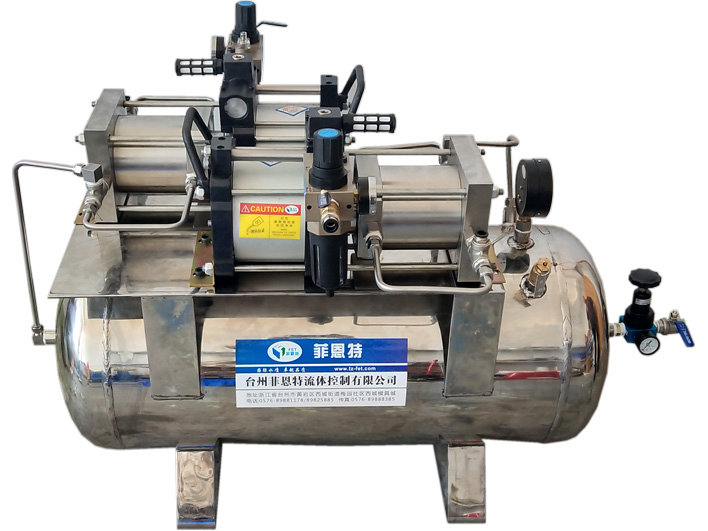 Gas Boosting System - High Purity
 Gas booster pump secondary gas

