
Mobile phone: 18815239758 (same as WeChat)
Phone: 0576-89881178
Phone: 0576-89825885


1. Multiple gas drives: compressed air Nitrogen, hydrogen, and other gases can be used as driving gas sources for pumps.
2. Wide range of applications: Used in the industrial field for clamping machine tool chucks, inflating energy storage devices, inflating high-pressure bottles, converting low-pressure gases into high-pressure gases, etc. Whenever the gas source pressure is not high enough, whether it is mechanical or testing equipment, a booster pump can be used.
3. Automatic pressure maintenance: Regardless of the reason for the pressure drop in the pressure maintenance circuit, the booster pump will automatically start to supplement the leakage pressure and maintain a constant circuit pressure.
4. Stable operation: Gas driven, no arc or spark, fully used in places with flammable and explosive liquids or gases.
5. Easy maintenance: Compared with other gas driven pumps, the booster pump can complete the same work, but it has fewer parts and seals, making maintenance simple.
6. High cost-effectiveness: The booster pump is a type of plunger pump that rapidly reciprocates during operation. As the output pressure increases, the pump's reciprocating motion slows down until it stops. At this point, the pump's pressure remains constant and energy consumption increases
Low, all components stop moving.
Composition and principle
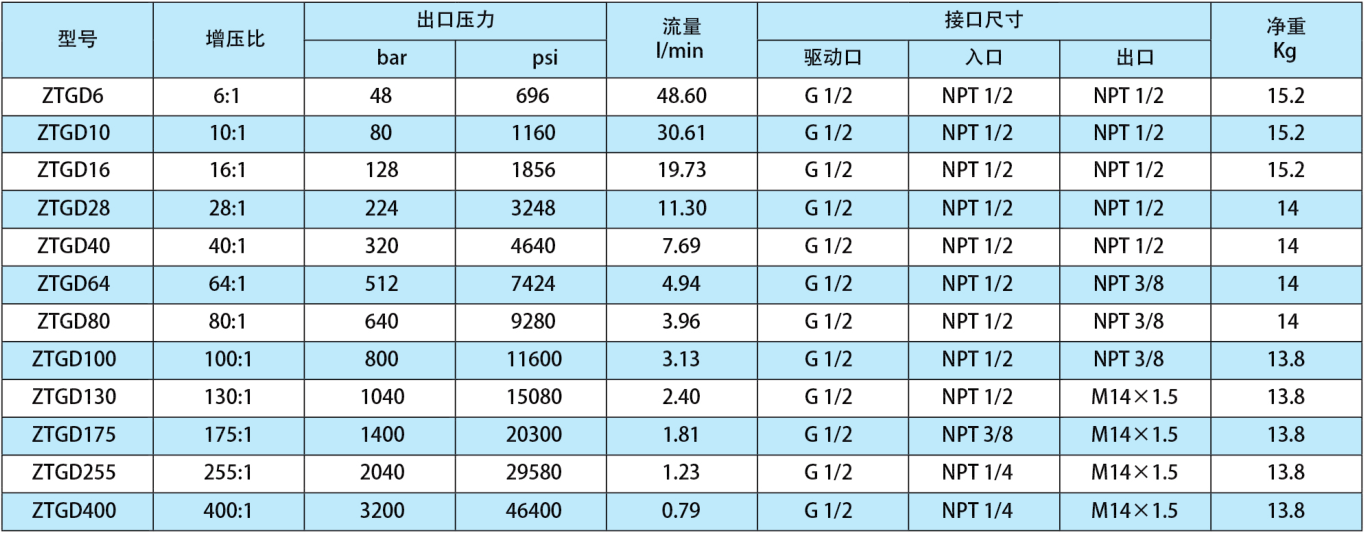 Pressure pump parameters
1. The gas section consists of a lightweight reducing piston with an O-ring seal and a sleeve wrapped with outer glass fiber or hard aluminum coating and filled with epoxy resin in the middle. The piston is placed inside the sleeve. The diameter of this air piston is constant for any series of pneumatic pumps. When compressed air is sent into the pneumatic device, it forces the piston into the compression stroke, and then the air drives the piston back to perform the suction stroke. Unlike many other pumps, the pneumatic device pipeline does not require the use of lubricants due to the inherent low friction characteristics of Feentor's design and lubrication during assembly.
2. The piston/plunger of the hydraulic device is directly connected to the piston, and its lower end is installed inside the hydraulic device housing. Its diameter determines the compression ratio of the pump, thereby determining the output flow rate and pressure. Its function is to suck liquid in through the inlet control valve and let it flow out through the outlet control valve at a higher pressure. The device is equipped with a spring check valve for controlling the liquid inlet and outlet channels. When the piston/plunger of the hydraulic device is in the suction stroke, the inlet control valve opens and the outlet control valve is held closed by a spring, introducing liquid into the pump. During the boost stroke, the inlet control valve closes, and the piston/plunger of the hydraulic device forces the liquid to flow out through the outlet control valve. The dynamic sealing ring is located around the piston/plunger of the hydraulic device and is an almost wear-resistant component. Its function is to hold liquid under pressure during circulation and prevent external leakage or infiltration of gas devices. Different sealing materials and forms were selected based on the medium, operating temperature, and pressure ratio of the pumped liquid. Note: Most Feentor pumps use a positioning element between the pneumatic and hydraulic parts to completely separate them and perform pollution-free operation.
3. The air circulation valve is composed of a controller and a plunger, which allows compressed air to flow to any end of the air piston according to its position. The piston pushes the control valve at the upper and lower ends of its stroke, alternately boosting and ventilating the large area of the slide valve to control the reciprocating motion of the airflow towards the air piston and maintain a circulating state. When air is discharged from the pump, it needs to pass through an exhaust muffler. Unlike many other pumps, the Feentor pump does not use a metal to metal tight fit in its design, which can prevent the consequences of plunger termination due to air leakage.
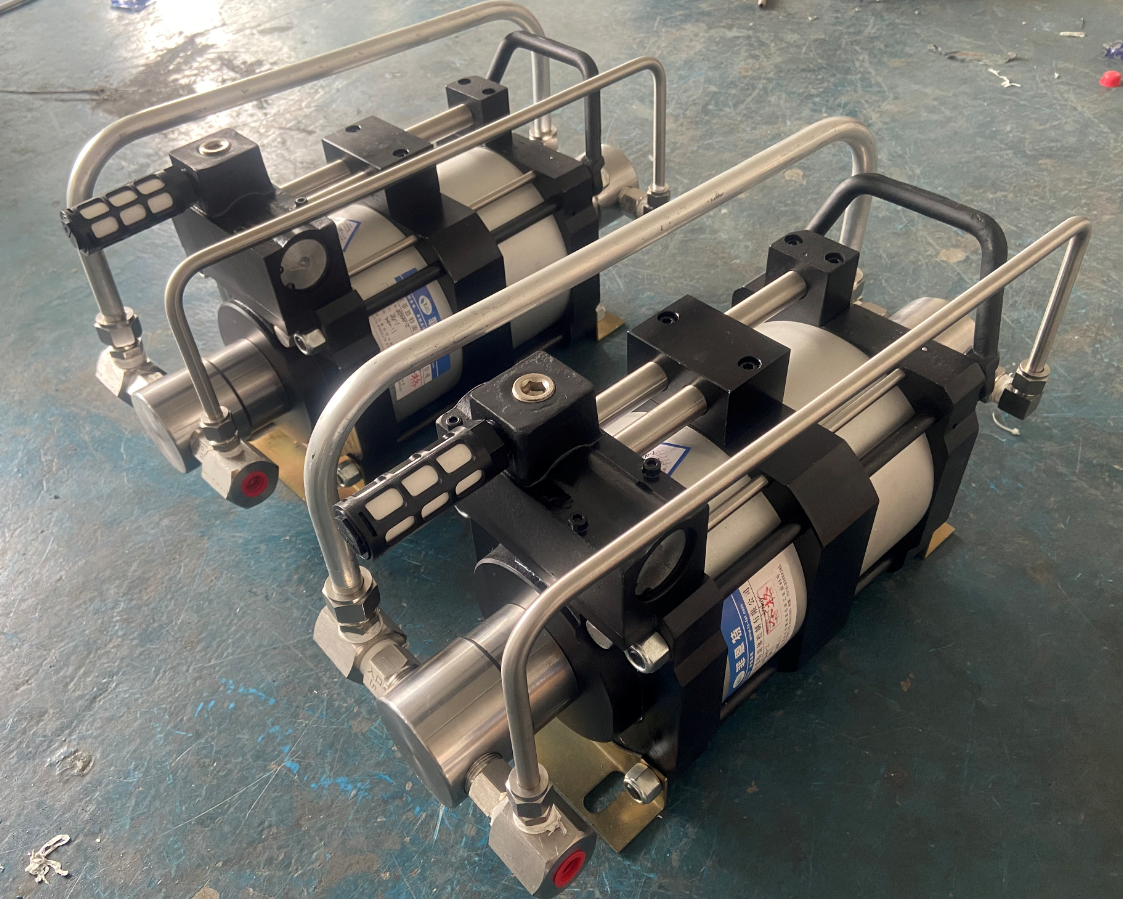 Pressure pump dual drive
Legal statement: The above content belongs to the copyright of Taizhou Feentor - Plagiarism will be prosecuted
