
Mobile phone: 18815239758 (same as WeChat)
Phone: 0576-89881178
Phone: 0576-89825885


There are many manufacturers producing air booster pumps, gas booster pumps, and liquid booster pumps today, and their technologies and processes are not the same. How can we distinguish the differences and quality between products with the same boost ratio? The air booster pump editor is here to briefly introduce several judgment methods to everyone.
1. Listen: Run the air booster pump, gas booster pump, and liquid booster pump, listen for their directional changes and running sounds. Hearing the metallic impact sound of Dangdang proves that there is a defect in their internal design. Soon, the popping sound is due to defects in their directional changes and stroke.
2. Look: Good air booster pumps, gas booster pumps, and liquid booster pumps have relatively large cylinder diameters and strokes. Technologically advanced factories have eliminated prominent external parts and replaced them with built-in ones, resulting in a more elegant and aesthetically pleasing overall appearance. Check if the booster cylinder is a double-layer cylinder and what material it is made of. Generally, air or gas booster pumps with less than ten times the size have more single-layer cylinders, while those with more than ten times the size are double-layer cylinders. For example, the Feentor ZTA10 gas booster pump uses a double-layer cylinder body with an inner layer of 304 stainless steel and an outer layer of aluminum alloy for heat dissipation and stability.
3. Touch: Run the air booster pump, gas booster pump, and liquid booster pump for half an hour to check if the cylinder is heating up. If the temperature is normal or low, it proves that the heat dissipation performance is good. Excessive temperature indicates that its internal structure is unreasonable, leading to increased friction and poor heat dissipation.
4. Blockage: Air booster pumps, gas booster pumps, and liquid booster pumps are equipped with ventilation holes, such as the Fiest gas booster pump. Use a well sealed object or finger to block the ventilation holes during the operation of the booster pump. If the booster pump stops working, it proves that it is running normally. If it continues to work, it will be due to inadequate design or workmanship, resulting in incomplete sealing, which will affect the purity of the subsequent boosted medium and the boost ratio disproportionately.
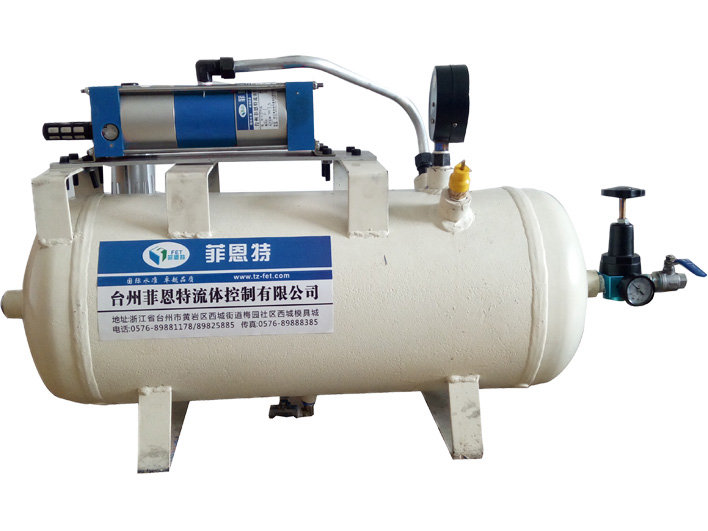 Compressed air booster pump
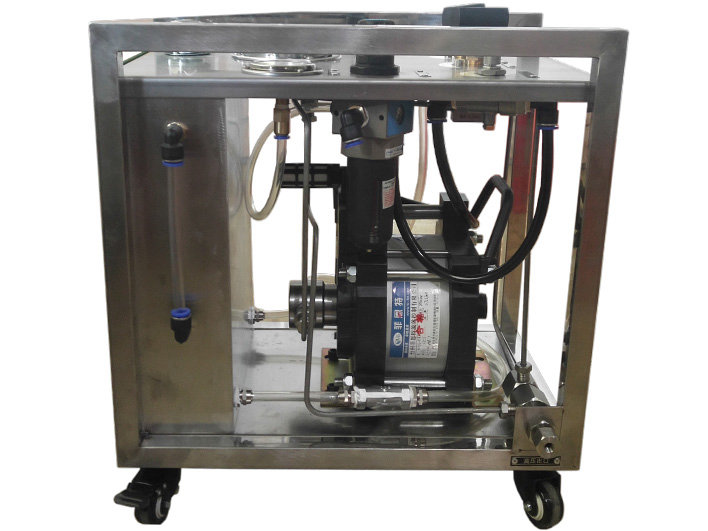 Hydraulic pressure test of liquid pressurization system

